



Acoustic comfort or soundproofing: what your project really needs
At the specification stage, few mix-ups are as costly as confusing acoustic comfort with soundproofing. They are two different goals, with different physics, different materials and different budgets. And yet, in tender documents, project reports and site conversations they are used as synonyms almost every day.
The result is predictable: rooms that have been "soundproofed" with absorbent panels and still let noise through to the room next door, or "treated" spaces that reverberate because in reality only the perimeter insulation was dealt with. This bridging article explains the difference between the two concepts, when to choose each one, what the Spanish CTE DB-HR says and how Fastmount accessible concealed fixing solves both scenarios without giving up access or finish.
01The two acoustic problems are not the same problem
The acoustics of a project are played out on two levels that should not be mixed up.
Acoustic treatment (acoustic comfort): controlling sound within the room
The acoustic treatment —what we colloquially call acoustic comfort— is about how sound behaves once it is inside a room. The typical problem is excessive reverberation: voices overlap with themselves, speech intelligibility drops, a meeting becomes exhausting and a restaurant turns into an indecipherable murmur.
It is solved with sound-absorbing materials that reduce the reflected sound energy. The reference parameters are the absorption coefficient αw, the NRC and, above all, the reverberation time (RT). The aim is not to stop sound getting in or out, but for the room to "sound good".
Sound insulation (soundproofing): stopping noise passing between rooms
The sound insulation —soundproofing— pursues the opposite: that noise is not transmitted from one room to another (or to the outside). It is solved with mass, decoupling and airtightness. The reference parameter is the sound reduction index Rw. An absorbent panel hung on the wall hardly changes the Rw: absorbing is not the same as insulating.
If the problem is heard within the room → acoustic treatment. If the problem comes from outside or bothers people outside → insulation.
02Acoustic comfort vs soundproofing: comparison table
| Criterion | Acoustic comfort | Soundproofing |
|---|---|---|
| Goal | Control reverberation within the room | Stop noise transmission between rooms |
| Problem it solves | Echo, poor intelligibility, acoustic fatigue | Lack of privacy, noise intrusion |
| Physical principle | Absorption of sound energy | Mass, decoupling and airtightness |
| Parameters | αw, NRC, reverberation time (RT) | Sound reduction index Rw |
| Typical materials | Sound-absorbing panels, baffles, absorbent ceilings, textiles | Multi-layer partitions, mass, resilient strips, soundproofing membranes |
| Sign that it is failing | "This room booms" | "You can hear everything next door" |
The practical conclusion is that it is rarely a matter of choosing one or the other: many projects need both, but applied in the right place and with the right solution.
03When to choose each one, by sector
Offices. Meeting rooms need insulation from the open-plan area (privacy), while the open-plan area itself needs acoustic treatment to lower reverberation and background noise.
Hotels. Guests value not hearing the room next door (insulation), but common areas call for acoustic treatment so that conversation flows. It is a sector where the CTE DB-HR is particularly demanding.
Restaurants. The number one pain point is reverberation: hard surfaces, high ceilings and occupancy. The focus is acoustic comfort; insulation comes in if there is live music or homes above.
04What the CTE DB-HR says (with the right nuance)
The Basic Document HR "Protection against noise" regulates both things: it requires minimum insulation values between rooms and sets reverberation time limits for residential, hotel, educational and administrative uses. Two warnings for the project report:
- DB-HR is not only about insulation. It also sets reverberation targets, so "complying with the CTE" may require dealing with acoustic comfort.
- Specific values are referred to testing and the technical data sheet. The real performance of a system (Rw, αw, RT) depends on the complete assembly, not just the material.
05Where Fastmount fits: solving acoustics without giving up access
Many acoustic solutions take the form of panels on walls and ceilings. The classic problem: once screwed or glued, the panel is no longer accessible, and behind it there are usually services or the need to replace a damaged piece.
Fastmount is a system of concealed male-female fixing, of nautical origin and now fully adopted in architecture, contract and interior design:
- Panel 100 % accessible and removable without tools or with a suction cup.
- No visible screws: the acoustic finish stays clean and continuous.
- Adjustment tolerance and perfect alignment, key on large ceilings.
- Reusable and suitable for walls, ceilings and curves.
A range for each type of panel
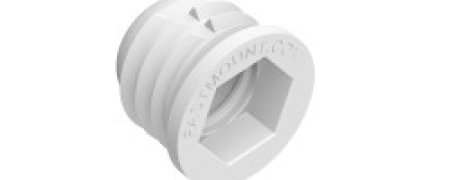 StandardGeneral panel use
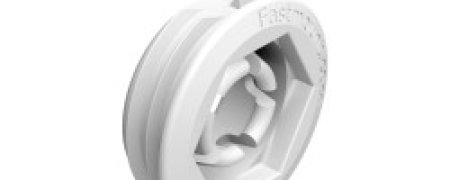 Low ProfileThin panels
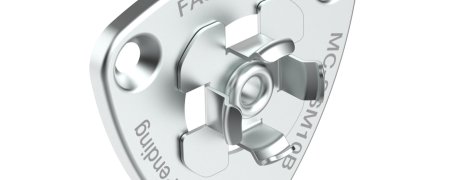 MetalHigh load and fire
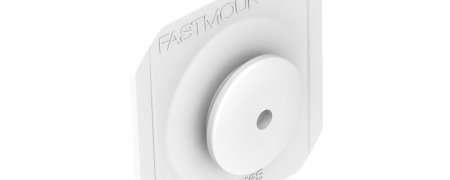 TextileCushions (~32 kg)
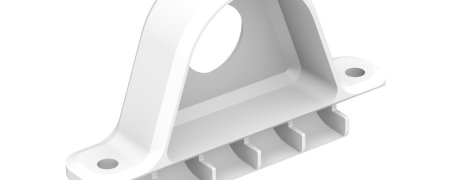 StratLockLarge formats
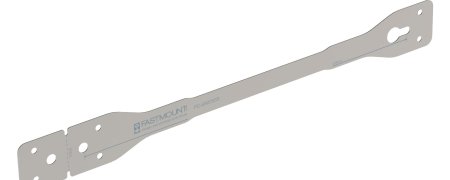 Panel ControlSeismic retention
Comfort and insulation with the same accessibility criterion
For acoustic comfort, Fastmount lets you fit perfectly aligned sound-absorbing panels, without screws and removable for cleaning or replacement. For insulation, Riviera Trade also offers its own soundproofing product RVT650, which is combined in a single assembly —acoustic panel + RVT650 + Fastmount clip— adding mass to the assembly while keeping the panel accessible.
06How to decide on your next project
- Define the problem: reverberation inside or transmission between rooms? Often, both.
- Assign the solution to the right place: absorption on interior surfaces; mass and decoupling in separating elements.
- Check DB-HR for your use and refer values to testing.
- Choose the fixing with maintenance in mind: an accessible panel today saves you a demolition tomorrow.
Do you already know what your project needs?
Size clips, range and budget in minutes, with the option of combining the RVT650 soundproofing product. As the official Fastmount distributor for Spain and Portugal, we help you solve acoustic comfort and soundproofing with panels that remain accessible.
Calculate my quote Talk to a technicianThe application images belong to Fastmount™. No acoustic values are claimed: all performance is referred to testing and the technical data sheet.